The journey that bridged continents and the treatment that bridged conservation disciplines.
One hundred sixteen (116) years ago, in December of 1907, American battleships embarked on a nearly 45,000 mile journey around the globe on the orders of President Theodore Roosevelt. Though an obvious display to the world of American naval prowess, the fleet’s stated primary mission was as a ‘Naval courtesy call’ to make friendly visits to other world powers. With stark white hulls in line with the navy peacetime color scheme, the 16 battleships carrying 14,500 officers became known as The Great White Fleet, the largest and most powerful fleet to have circumnavigated the globe at that point. The vessel of our story is the USS Vermont.
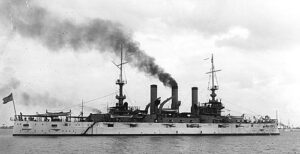
USS Battleship Vermont, commissioned in 1907, First Division. Naval Historical Center, Photographic Collection.
Great White Fleet officers and sailors immortalized their lengthy journey with a variety of souvenirs, primarily textile-based, many of which still survive. Handkerchiefs, flags, pillowcases, ribbons and banners were collected along the way, and exist today as a fascinating look into the ways Americans commemorated militarism in the early 20th century. The handmade souvenirs show the ways foreign craftsmen adapted existing traditions and motifs to meet American demands and taste.
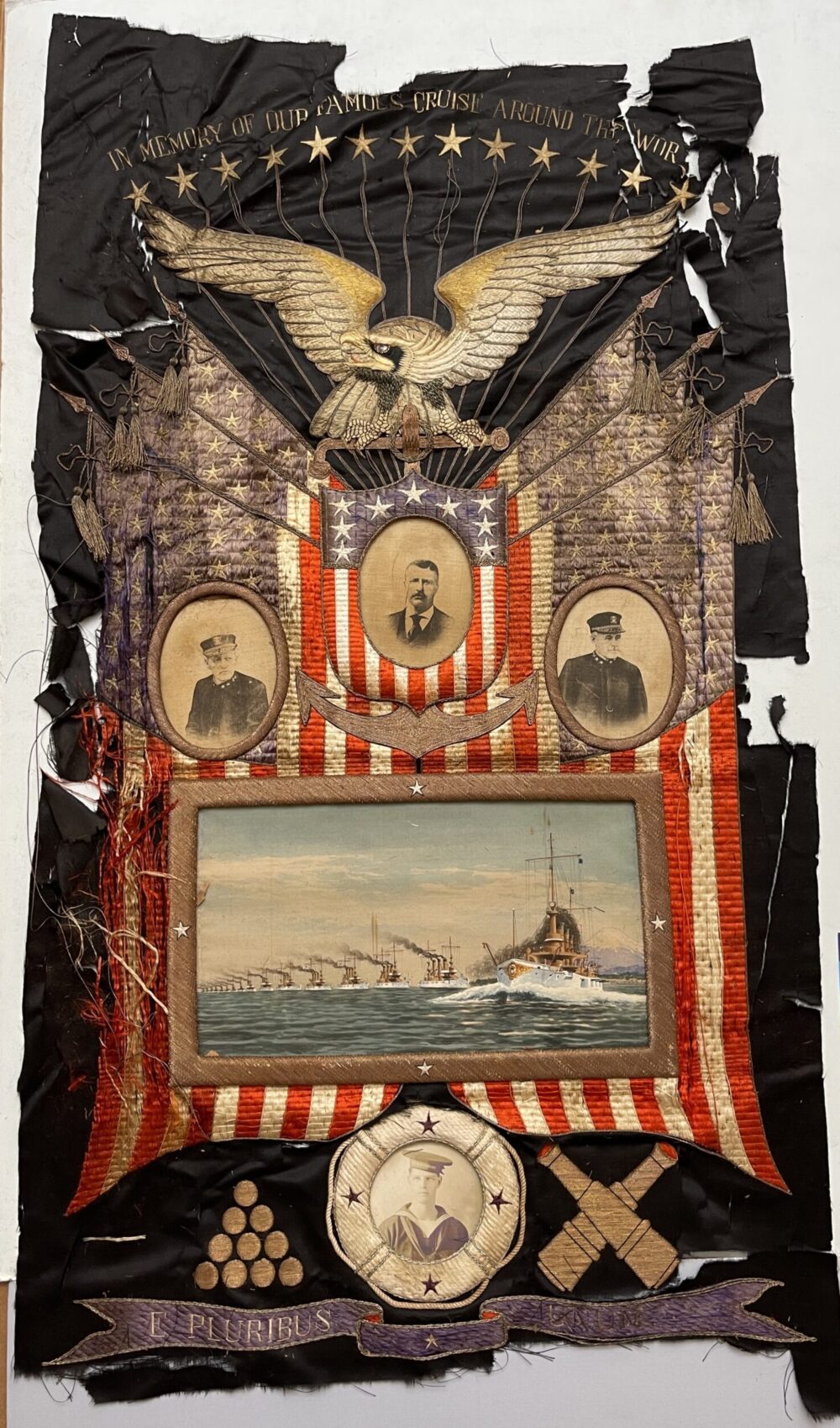
In Memory of Our Famous Cruise Around the World
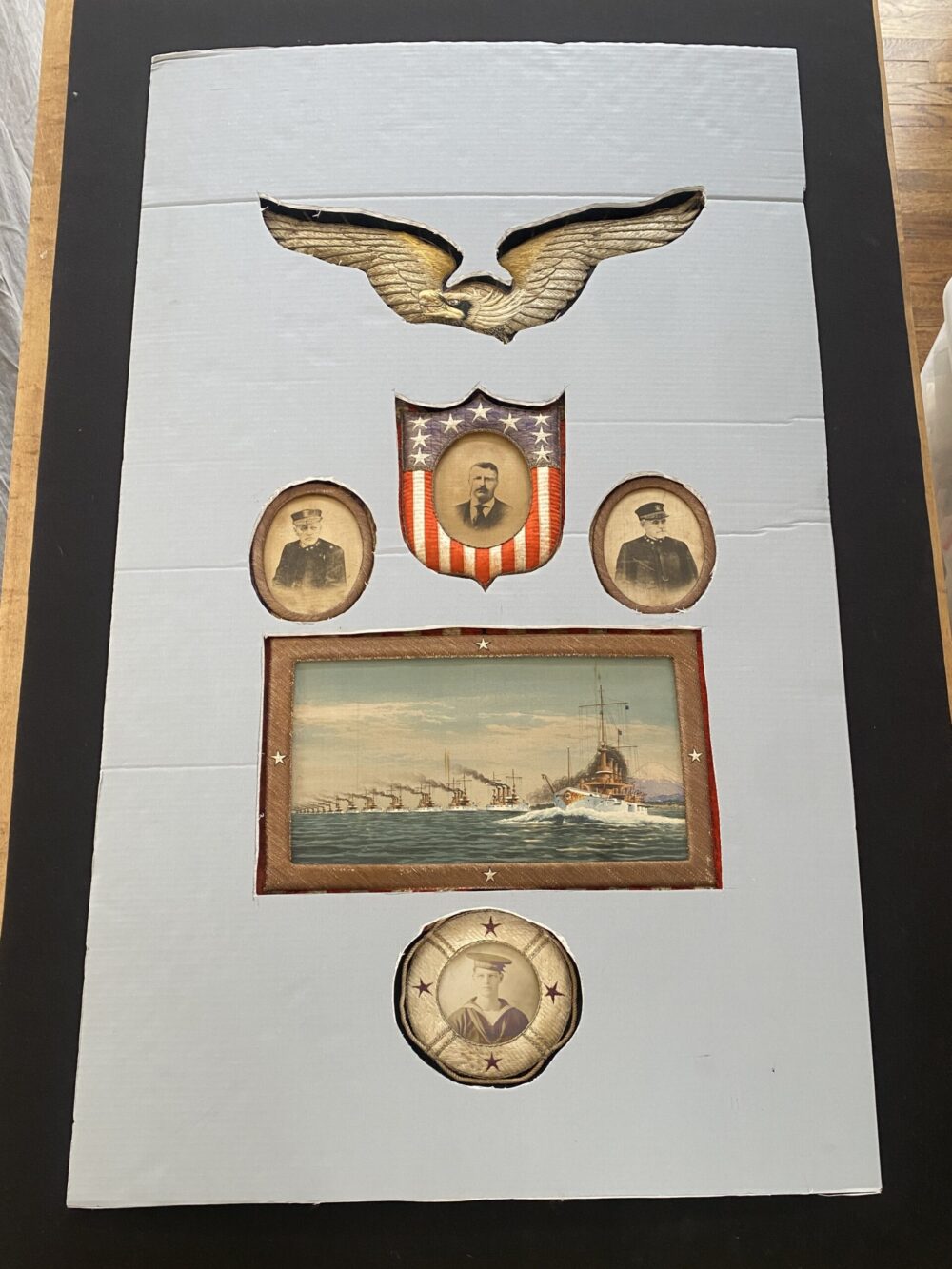
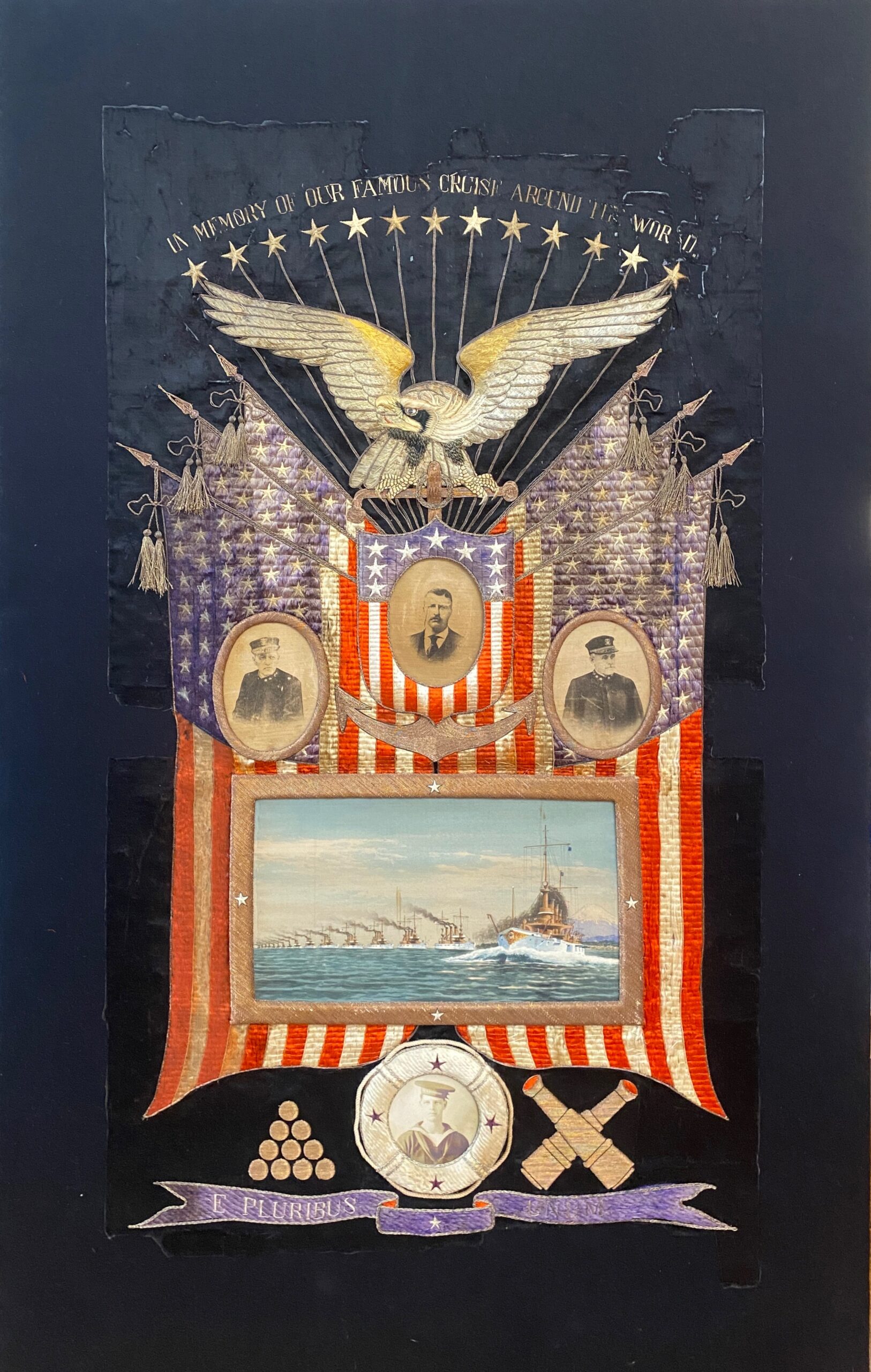
One such memento, a lavish banner commissioned by a young sailor aboard the USS Vermont, made its way to our conservation studio in a dire state. The glass frame had shattered, shredding the black silk ground and embroidery. While in tatters, the damage could not disguise the beauty and impressive handiwork of the textile. Alongside embroidered silk flatwork and laid metallic couching, the piece includes a large trapunto eagle, as well as three framed photo portraits printed on silk. At the bottom, a large framed scene painted from watercolor on silk depicts The Fleet itself steaming past Mount Fuji.
Existing catalogues and other versions of this piece, in which the original packaging survived, reveal that these banners were created in Yokohama, Japan by G. Fukuughi of the George Washington Company, a Dealer in Fine Art Goods. For $10 (about $1000 today), a sailor could own a customized banner, with his photo mounted under President Roosevelt, Admiral Evans, and Admiral Sperry.
Though the actual sailor is anonymous (how we wonder who the young seaman is……), the care, resources, and memory embedded in this textile demand that today we invest a similar amount of energy and care into preserving it.
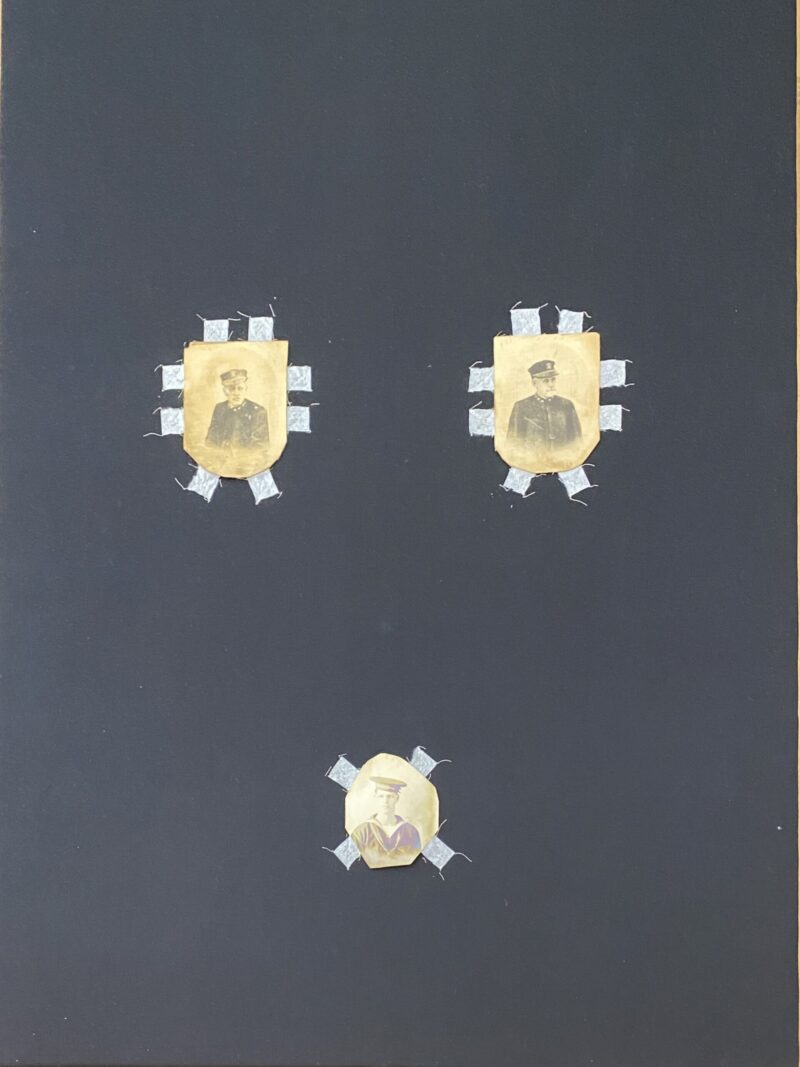
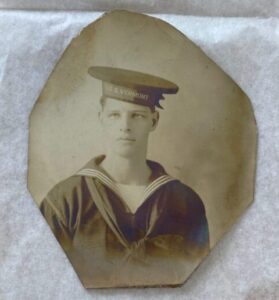
Photograph of a young sailor aboard the USS Vermont after removal from its frame for cleaning. While the other three photographs are printed on silk, this photo was printed on paper. Most likely, this was a photo already owned by the sailor and added to the banner after purchasing.
Challenges in the Third Dimension and a Call for Backup
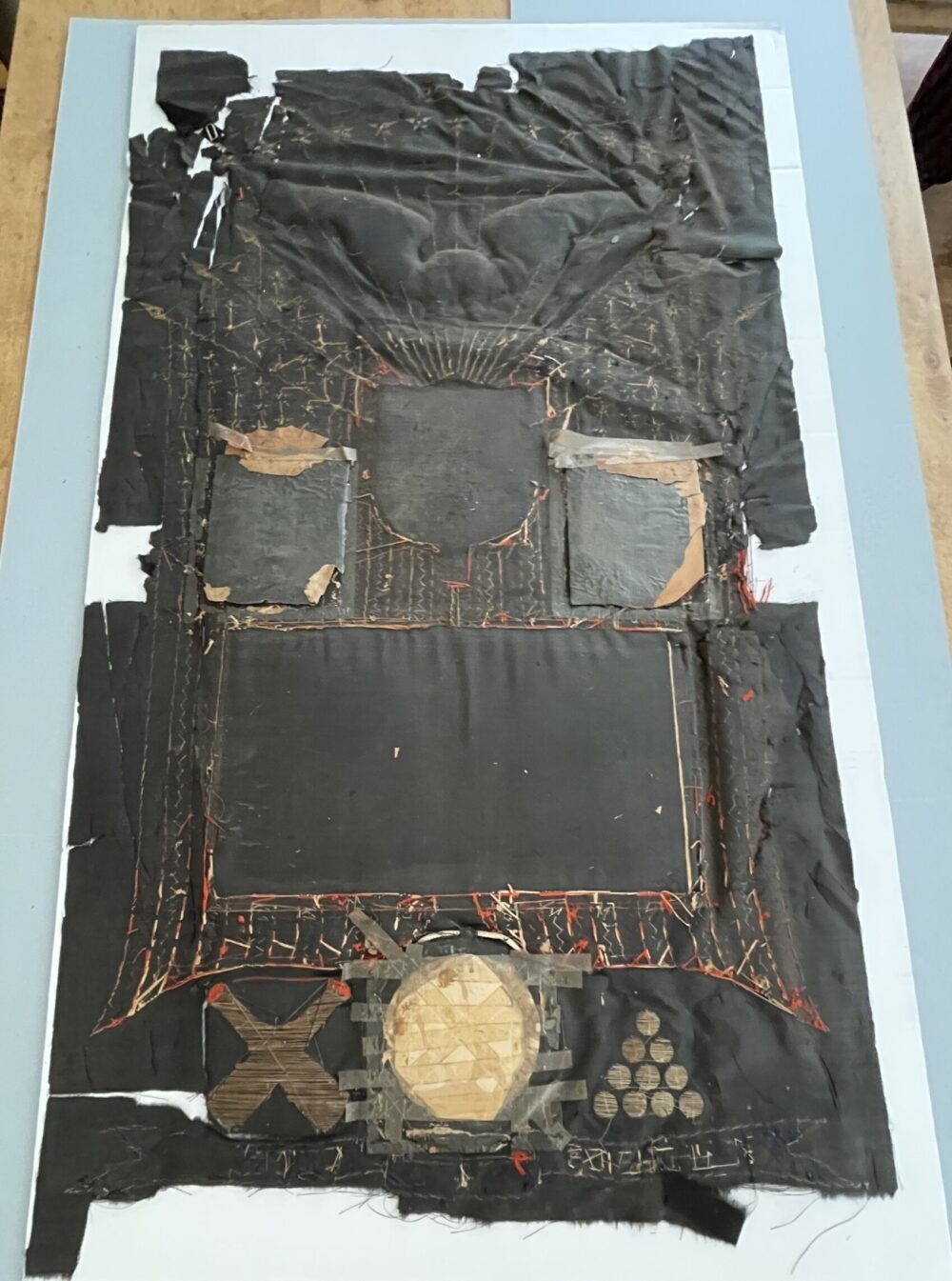
In order to restore the banner to its former glory and visual splendor re-framed in a place of prominence, there were multiple challenges – structural and surface. For one, the magnificent Trapunto eagle (a technique in which stuffing is placed behind the embroidered surface to create 3 dimensional relief) and the framed elements forced us to get creative in the treatment (rescue) of the shattered silk. The silk ground was so brittle and powdering, it was impossible to stitch directly into it. Therefore stabilization called for a full adhesive lining.
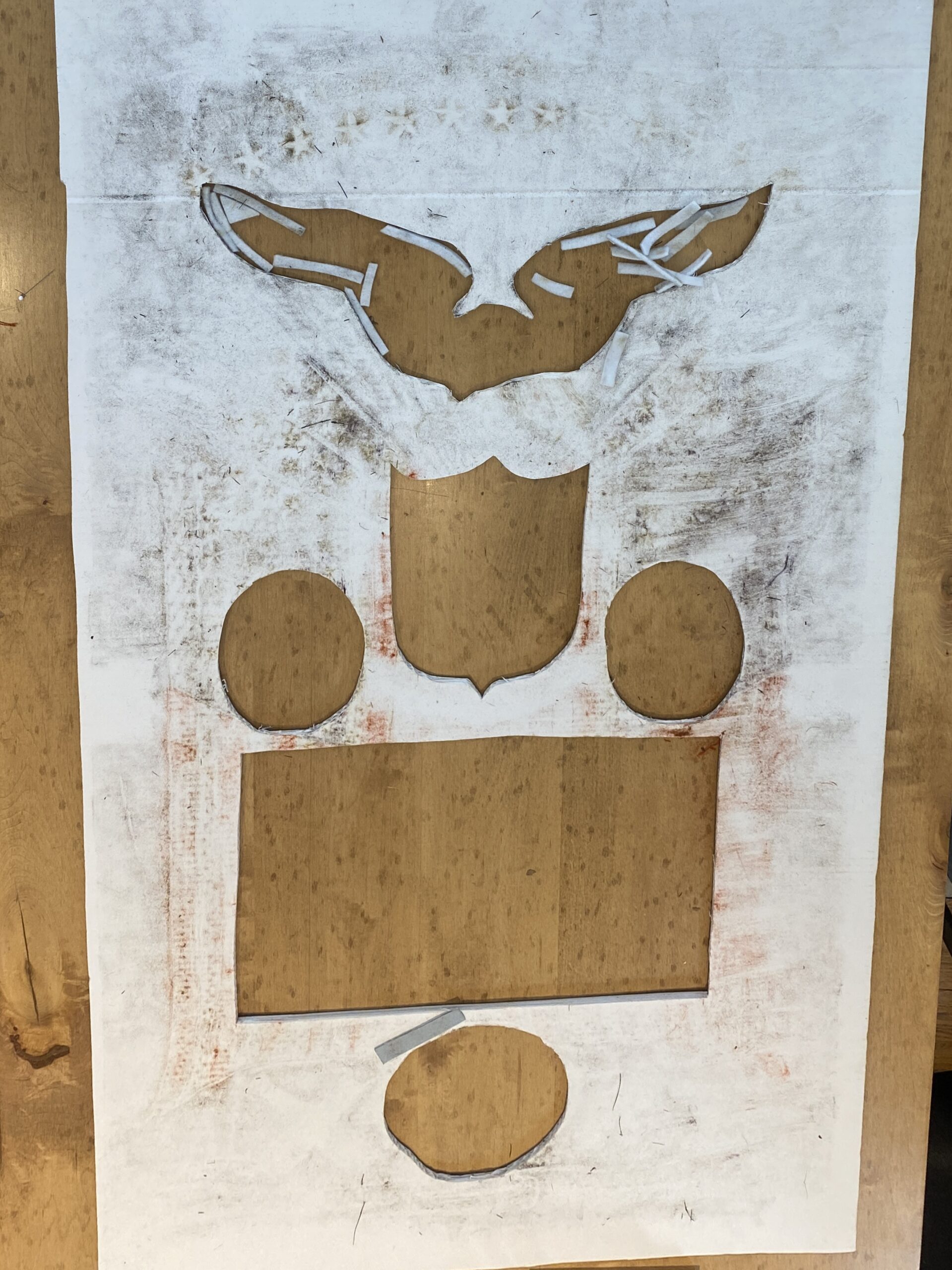
A custom relief board was created to create a planar surface, with foam padding on any sharp edges. When flipped over for lining application on the reverse side, the three dimensional elements sat nestled and un-crushed within their relief cut outs. Note the powdering silk residue in the photo on the right, evidence of a very brittle and friable silk ground.
The non-textile elements also called for specific consideration before preceding. As with many things in life, in conservation it’s important to know the limits of your knowledge and reach out to those with the relevant expertise. Luckily the hand painting of the fleet was in immaculate condition. To guide the cleaning and mounting of the three silk portrait photos and sailor photo on paper, we reached out to my colleague Jessica Keister, conservator at the Carnegie Museum of Art. After removal from their original ‘textile’ frames, the photos were surface cleaned and residual acidic adhesive was removed. Using Japanese wheat starch paste, mulberry paper strips were attached along the edges of the photos. These added ‘tabs’ were then hand stitched directly to fabric covered display mount. Thus, seamlessly combining the preservation needs of both mediums.
Silk banner before and after conservation. The final step was stitch mounting the whole banner to the prepared display mount, anchoring our stitches through the rigid coroplast mount for maximum stability.
A Keepsake Conserved
Though The Great White Fleet finished its voyage over a century ago, its journey lost to time for many Americans, the pride felt by its sailors and the skill exhibited by those artisans who commemorated the expedition, will live on through conservation and display. This banner will travel on to the Army Navy Club, Washington DC, so that our young unknown USS Vermont sailor, enshrined in his framed ‘porthole,’ may be remembered into the 21st century and beyond.
Silk banner before and after conservation. The final step was stitch mounting the whole banner to the prepared display mount, anchoring our stitches through the rigid coroplast mount for maximum stability.
Though The Great White Fleet finished its voyage over a century ago, its journey lost to time for many Americans, the pride felt by its sailors and the skill exhibited by those artisans who commemorated the expedition, will live on through conservation and display. This banner will travel on to the Army Navy Club, Washington DC, so that our young unknown USS Vermont sailor, enshrined in his framed ‘porthole,’ may be remembered into the 21st century and beyond.
Work Cited
Crawford, Michael J., and Donald C. Winter. The World Cruise of the Great White Fleet: Honoring 100 Years of Global Partnerships and Security. Naval Historical Center, 2008.
Miller, Zach. “US Militaria Forum Research and Discussion Historical Militaria.” Great White Fleet Silk Work, www.usmilitariaforum.com/forums/index.php. Accessed 10 Jan. 2026.
“Rare Silk and Gilt-Embroidered Theodore Roosevelt and the Great White Fleet Banner, Manufactured by The George Washington Co., Yokohama, Japan, circa 1915.” Sothebys.Com, www.sothebys.com/en/auctions/ecatalogue/2011/important-americana-including-american-stoneware-assembled-by-mr-and-mrs-edwin-hochberg-n08710/lot.373.html. Accessed 10 Jan. 2026.
Stewart, William. “Fabric Souvenirs: A Tradition of Sailors.” GREAT WHITE FLEET, www.greatwhitefleet.us/home/fabric_souvenirs/. Accessed 3 Jan. 2026.
Key Words: textile conservation, stabilization, silk, silk embroidery, trapunto, fragile, laid couching, photo conservation, Great White Fleet, Naval History, USS Vermont, military history, Admiral Evans, Admiral Sperry, President Theodore Roosevelt.
All photos by Caring for Textiles, unless otherwise noted.
I continue to be astounded by the work that you and your assistants have been performing. Bravo!!
How wonderful! You all are to be congratulated on this spectacular job! Wouldn’t it be great if a descendant of the anonymous sailor recognizes his photo?!